Scoring · Founding fathers
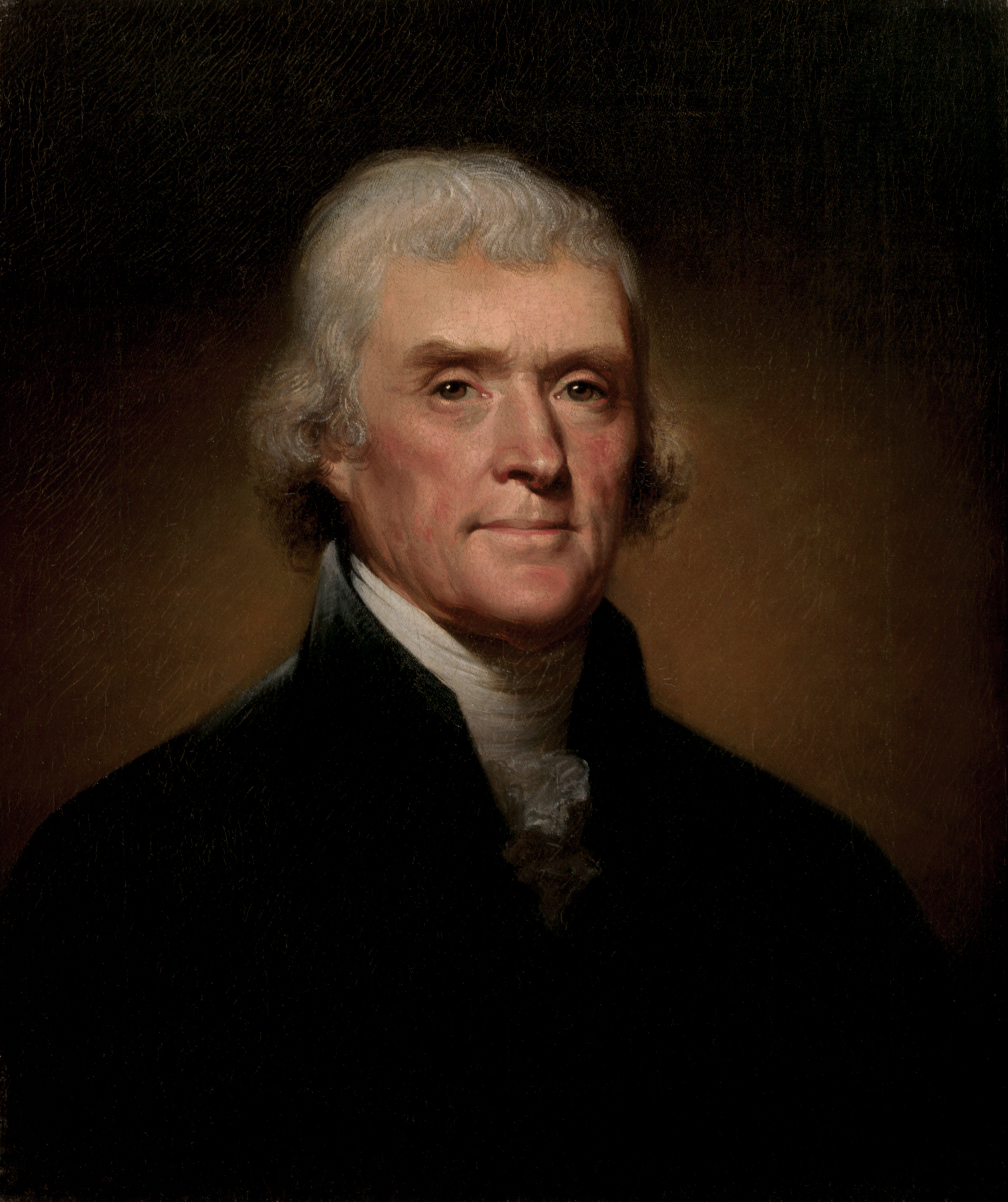
Jefferson, Thomas
1801–1809
Rembrandt Peale. Public domain via Wikimedia Commons.
Jefferson was the founders' most absolute defender of church-state separation and a free-press, agrarian-republican, anti-Hamilton-banking voice.49 Jefferson is the closest founder grade because both candidates have substantial alignment AND substantial disagreement with him — Paxton wins on states' rights but loses heavily on church-state separation, while Talarico tracks Jefferson on church-state and press but loses heavily on Hamiltonian federal expansion.
Issue
Paxton
Talarico
Virginia Statute for Religious Freedom
Hurts
Helps
Paxton: Hurts · Talarico: Helps
The Virginia Statute protected 'the Jew and the Gentile, the Christian and the Mahometan, the Hindoo and Infidel of every denomination'; Paxton's Ten Commandments mandates and prosecutions of Muslim and Catholic institutions35 are exactly what the Statute forbids, while Talarico's church-state separation tracks the Statute directly.
Ten Commandments mandate
Hurts
Helps
Paxton: Hurts · Talarico: Helps
Jefferson's church-state framework directly contradicts any Ten Commandments mandate; Paxton champions the Texas mandate, while Talarico has campaigned against state-imposed religious displays on Jeffersonian grounds.
Protection of Muslims from state interference
Hurts
Helps
Paxton: Hurts · Talarico: Helps
Jefferson explicitly protected 'the Mahometan' from state interference; Paxton's CAIR investigation and EPIC City litigation against a Muslim community35 are the opposite of that protection, while Talarico's explicit defense of Texas Muslim communities (including his pushback on the EPIC City probe) tracks Jefferson's protection-for-the-Mahometan directly.
'Wall of separation' (Danbury Baptists letter)
Hurts
Helps
Paxton: Hurts · Talarico: Helps
Jefferson's Danbury Baptists letter coined the 'wall of separation between Church and State'; Paxton's program collapses that wall, while Talarico's church-state separation is the modern instantiation of the metaphor.
Free press absolutism
Helps
Helps
Paxton: Helps · Talarico: Helps
Jefferson was a free-press absolutist even when attacked viciously; both Paxton and Talarico operate on free-press terms in conventional ways, so each gets partial credit on this axis without it being decisive for either.
States' rights / small federal government
Helps
Hurts
Paxton: Helps · Talarico: Hurts
Jefferson preferred small federal government and robust state authority; Paxton's states'-rights and anti-large-federal-government framing earns partial credit here, while Talarico's expanded federal economic agenda is exactly the Hamiltonian overreach Jefferson loathed.
Agrarian-republican vision (anti-monopoly / independent-producer economy)
Helps
Helps
Paxton: Helps · Talarico: Helps
Jefferson's yeoman-farmer republic was anti-concentration on two fronts — anti-monopoly and pro-independent-producer; Paxton's Big Tech antitrust litigation against Google and Meta lands on the anti-concentration side, while Talarico's rural-broadband, rural-hospital, and small-producer framing lands on the independent-producer side. Each gets partial credit on a different sub-axis of the same Jeffersonian concern.
Anti-Hamilton-banking
—
Hurts
Paxton: — · Talarico: Hurts
Jefferson opposed Hamiltonian banking centralization; Talarico's federal-economic agenda sits on the Hamiltonian side of that fight and costs him points on this Jeffersonian axis. Paxton has not made banking centralization or federal-monetary structure a campaign theme and is not a factor on this narrow row.
Anti-corruption / expanded democracy
Hurts
Helps
Paxton: Hurts · Talarico: Helps
Jefferson framed corruption and concentrated power as the chief threats to a free people; Talarico's anti-corruption package and expanded-democracy framing2 track that concern, while Paxton's abuse-of-office impeachment and his Texas v. Pennsylvania election-overturning suit are the precise pattern of corruption and concentrated power Jefferson warned against.
Sources
- Ken Paxton for U.S. Senate, official campaign issues page, accessed May 2026. (full list)
- Talarico for Texas, official campaign issues pages (taxes, education, healthcare, immigration, social media/AI, freedom-family-faith, public-safety-justice, corruption-democracy, labor-business), accessed May 2026. (full list)
- Texas Attorney General actions against CAIR, East Plano Islamic Center, and Catholic Annunciation House; ABC News and Tribune coverage, 2024-2026. (full list)
- Thomas Jefferson, Virginia Statute for Religious Freedom (drafted 1777, enacted 1786); 'Wall of Separation' letter to Danbury Baptists (1802); Notes on the State of Virginia; Louisiana Purchase (1803). (full list)