Scoring · Jurists
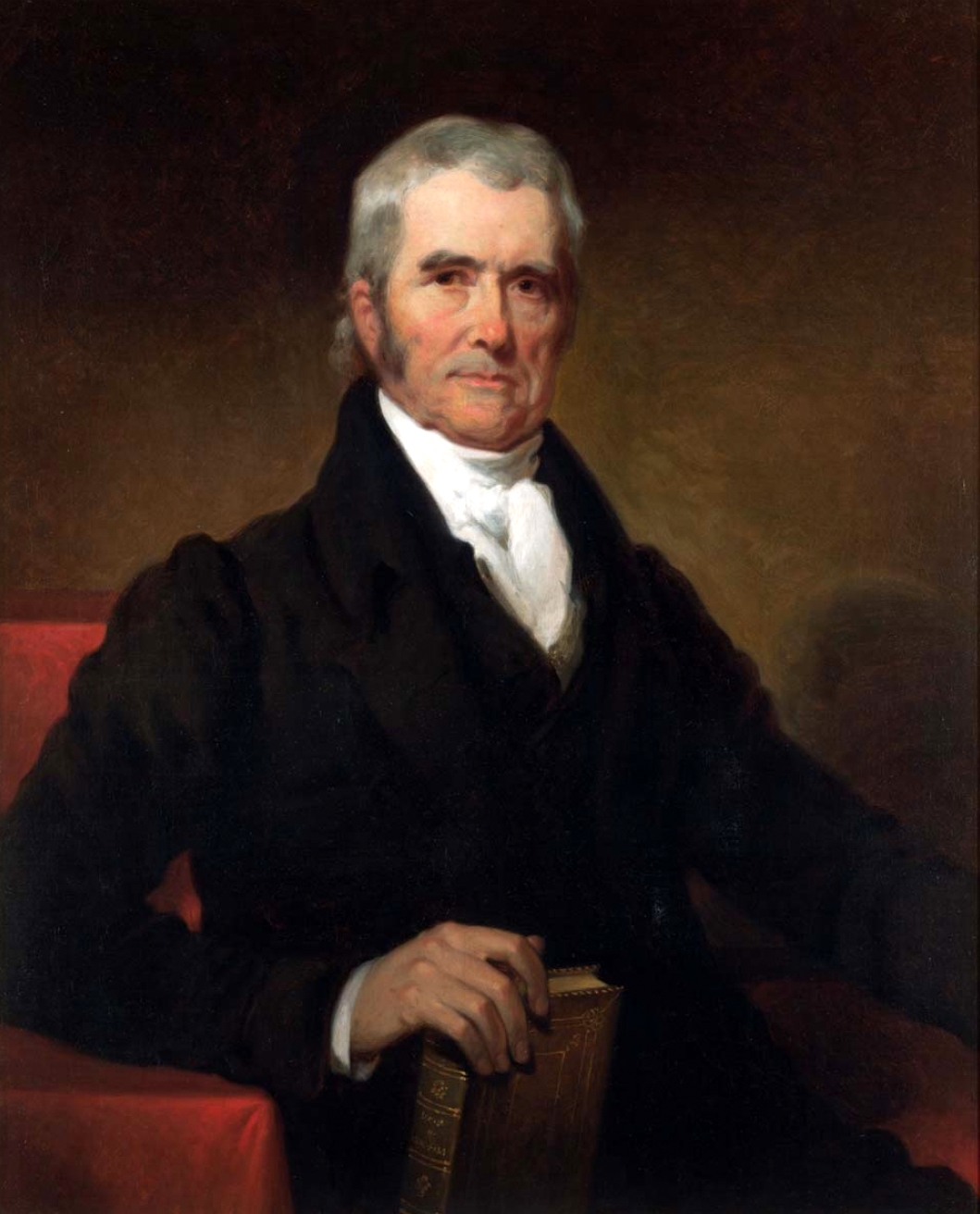
Marshall Court tradition
federal institutionalism, 1801–1835
Henry Inman. Public domain via Wikimedia Commons.
The Marshall Court (1801–1835) framework — judicial review (Marbury v. Madison), federal supremacy (McCulloch v. Maryland), broad Commerce Clause (Gibbons v. Ogden), and the judiciary as a coordinate branch above faction61 — runs against Paxton's forum-shopping (the inverse of neutral institutional process), his abuse-of-office impeachment (a core officer-of-the-court offense), and his political-loyalty campaign style, and is more legible to Talarico's anti-corruption framework, voting-rights advocacy, and institutional-restraint package, with partial federalism credit to Paxton's state-AG litigation as legitimate state-level constitutional action.
Issue
Paxton
Talarico
Judicial review / Marbury v. Madison
Hurts
Helps
Paxton: Hurts · Talarico: Helps
Marshall's Marbury established the Court as constitutional check above factional politics; Paxton's Texas v. Pennsylvania suit asking SCOTUS to overturn election results treats judicial review as a partisan instrument, while Talarico's institutional-restraint and judicial-independence package2 respects the Marbury frame.
Federal supremacy / McCulloch v. Maryland
Hurts
Helps
Paxton: Hurts · Talarico: Helps
McCulloch established federal supremacy and implied federal powers; Talarico's John Lewis VRA and federal voting-rights enforcement2 track the McCulloch federal-supremacy logic, while Paxton's anti-commandeering and 10th-Amendment-first state-AG litigation1 reads federal authority narrowly in ways McCulloch's broad-construction holding rejects.
Broad Commerce Clause / Gibbons v. Ogden
Hurts
Helps
Paxton: Hurts · Talarico: Helps
Gibbons read the Commerce Clause broadly to enable national economic regulation; Talarico's federal economic agenda (minimum wage, antitrust, financial regulation)2 operates inside the Gibbons broad-construction lineage, while Paxton's anti-ESG and anti-CFPB litigation1 challenges federal economic-regulatory reach in ways Gibbons's broad Commerce Clause reading rejects.
Officer-of-the-court integrity / faction over institution
Hurts
Helps
Paxton: Hurts · Talarico: Helps
Neutral institutional process / forum-shopping
Hurts
Helps
Paxton: Hurts · Talarico: Helps
The Marshall framework required neutral institutional process even when individual cases cut against political preferences; the documented forum-shopping practices Paxton's office relied on5 are the precise inverse of that neutrality, while Talarico's judicial-process reforms (random case-assignment rules, division-shopping limits)2 target the same procedural neutrality concern.
State-AG constitutional litigation
Helps
—
Paxton: Helps · Talarico: —
The Marshall Court's federal-supremacy framework would credit some of Paxton's state-AG litigation1 as legitimate state-level constitutional action, earning him partial federalism credit on this axis. Talarico's record on state-AG litigation is not a factor.
Sources
- Ken Paxton for U.S. Senate, official campaign issues page, accessed May 2026. (full list)
- Talarico for Texas, official campaign issues pages (taxes, education, healthcare, immigration, social media/AI, freedom-family-faith, public-safety-justice, corruption-democracy, labor-business), accessed May 2026. (full list)
- Patrick Svitek, 'Ken Paxton emerges victorious from yet another career scandal,' Texas Tribune, Sept. 17, 2023. (full list)
- Texas Tribune / ProPublica, 'Paxton files lawsuits in courts that could have more favorable outcomes,' May 20, 2026. (full list)
- John Marshall and the Marshall Court (1801-1835); Marbury v. Madison, 5 U.S. 137 (1803); McCulloch v. Maryland, 17 U.S. 316 (1819); Gibbons v. Ogden, 22 U.S. 1 (1824); R. Kent Newmyer, 'John Marshall and the Heroic Age of the Supreme Court' (2001). (full list)