Scoring · Public intellectuals
Friedman, Milton
1912–2006
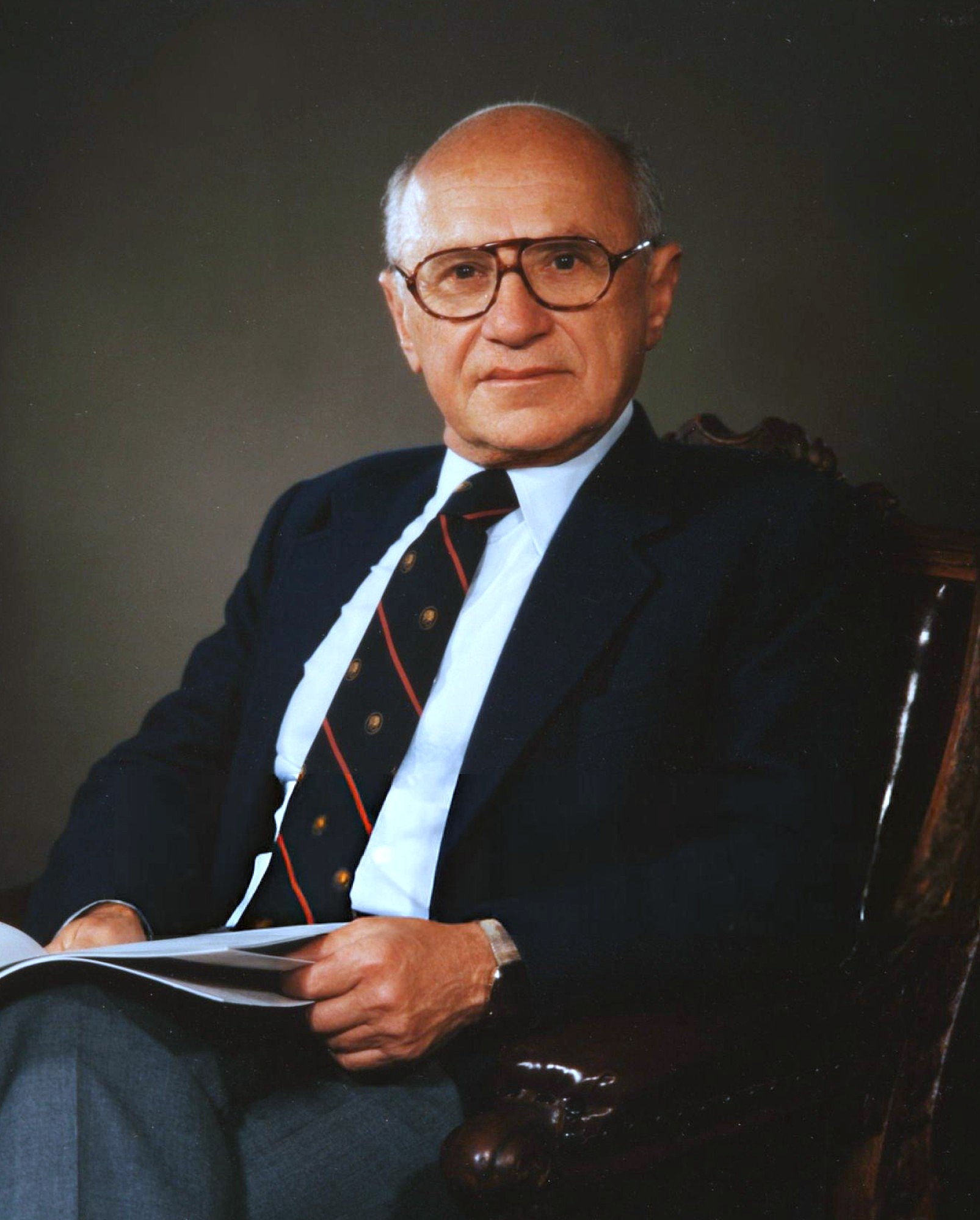
Bachrach Studios. Public domain via Wikimedia Commons.
Friedman's framework was free-market absolutism: he invented the modern school-voucher framework in 1955, advocated drug legalization, favored free trade, opposed government-led economic planning, and supported a negative income tax141. Abbott aligns on the SB 2 voucher centerpiece, deregulation, and tax-cutting; he departs on Trump tariffs and cannabis prohibition. Hinojosa runs against Friedman on vouchers and corporate-tax framing but earns Friedman credit on HB 81 decriminalization.
Issue
Abbott
Hinojosa
School vouchers / SB 2 ESA program
Helps
Hurts
Abbott: Helps · Hinojosa: Hurts
Deregulation / light-touch regulation
Helps
—
Abbott: Helps · Hinojosa: —
Friedman opposed government-led economic planning; Abbott's deregulation record (TRAIGA innovation sandbox, occupational licensing rollbacks) tracks the Friedman frame. Hinojosa's regulatory posture leans toward stakeholder protection (data-center cost allocation, anti-private-equity healthcare) rather than the Friedman deregulatory approach.1
Tax cutting
Helps
—
Abbott: Helps · Hinojosa: —
Friedman treated low marginal tax rates as the precondition for growth; Abbott's $18B property-tax cut and homestead-exemption increases align with that frame. Hinojosa's 'tax the billionaires and corporations' framing1 runs the other direction and does not earn Friedman points.
Trump tariffs / free trade
Hurts
—
Abbott: Hurts · Hinojosa: —
Friedman was a foundational free-trade economist; Abbott's defense of Trump tariffs5 is a direct departure from the Friedman frame and costs him roughly 1-2 points. Hinojosa has not made tariffs a signature issue, so this Friedman strand does not move her.
Cannabis / drug-legalization advocacy
Hurts
Helps
Abbott: Hurts · Hinojosa: Helps
Negative income tax / targeted poverty alleviation
—
Hurts
Abbott: — · Hinojosa: Hurts
Friedman proposed the negative income tax as the market-friendly substitute for sprawling welfare bureaucracy; Hinojosa's preferred levers (Medicaid expansion, wage-floor support)1 work through the bureaucratic-program channel Friedman wanted to replace with a NIT. Abbott has no negative-income-tax proposal either, but his record does not expand the program-based redistribution Friedman opposed.
Corporate-tax framing
—
Hurts
Abbott: — · Hinojosa: Hurts
Friedman rejected the 'social responsibility of business' framing and treated corporate-tax hikes as growth-suppressing; Hinojosa's billionaire-and-corporation tax framing1 sits opposite the Friedman frame. Abbott's franchise-tax cuts and exemptions track Friedman on this axis and do not move him against it.
Government-led economic planning
—
Hurts
Abbott: — · Hinojosa: Hurts
Friedman's central methodological commitment was anti-planning; Hinojosa's data-center cost-allocation framework and expanded social-insurance agenda1 imply more state-directed economic governance than the Friedman frame allows. Abbott's record is closer to the laissez-faire pole Friedman defended.
Sources
- Gina Hinojosa for Texas Governor, official campaign priorities page, accessed May 2026. (full list)
- CBS News Texas, 'Gov. Abbott says Trump uses tariffs as leverage to boost border security,' CBS News Texas, Feb. 2025. (full list)
- Sergio Martínez-Beltrán, 'Abbott signs $1 billion school voucher ESA law,' KUT, May 2, 2025. (full list)
- Texas Tribune, 'Texas Gov. Greg Abbott vetoes SB 3, the consumable hemp THC ban,' June 22, 2025. (full list)
- NORML, vote scorecard and candidate page for Gina Hinojosa — covers HB 2107, HB 81, HB 122, HB 1535, and SB 3 votes. (full list)
- Milton Friedman, Capitalism and Freedom (1962); Free to Choose (1980); 1955 school-voucher essay; drug-prohibition critique. (full list)