Scoring · Jurists
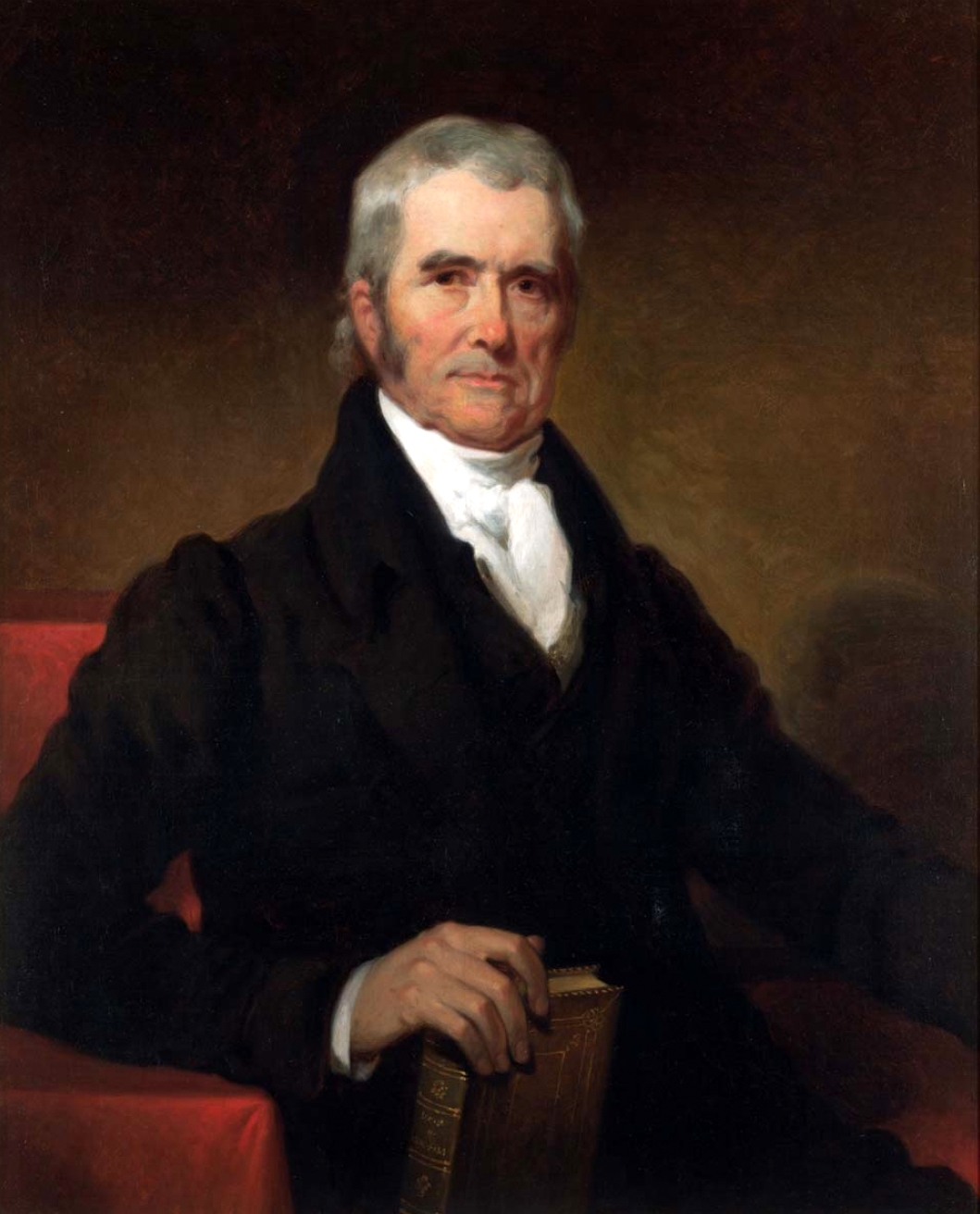
Marshall Court tradition
federal institutionalism, 1801–1835
Henry Inman. Public domain via Wikimedia Commons.
Marshall's framework133 prizes a strong federal judiciary, federal preemption, and judicial review against legislative excess. The August 2025 Texas Supreme Court refusal to vacate seats is a working modern example of judicial review checking the executive — Abbott gets marginal credit for accepting it. But his preemption fights against federal Medicaid and ACA cut against Marshall's federalist strand. Both candidates are mixed.
Issue
Abbott
Hinojosa
Judicial review against executive overreach (Aug 2025)
Mixed
Helps
Abbott: Mixed · Hinojosa: Helps
Marshall built the framework of judicial review as a check on the executive; Abbott asked the Texas Supreme Court to vacate Democratic House seats via quo warranto and the court refused30 — he deserves marginal credit for accepting the refusal without further escalation, while Hinojosa's reliance on courts to constrain the executive action is the affirmative Marshall move.
Federal preemption (Medicaid, ACA, postpartum)
Hurts
Helps
Abbott: Hurts · Hinojosa: Helps
Forcing judicial review forward (SB 10 AG-cost amendment)
—
Helps
Abbott: — · Hinojosa: Helps
Marshall treated judicial review as the engine of constitutional enforcement; Hinojosa's amendment placing SB 10 litigation cost on the AG48 (forcing the judicial-review question forward) is a smaller Marshall-style move. Abbott has not advanced a comparable mechanism.
Acceptance of court refusal without further escalation
Helps
Helps
Abbott: Helps · Hinojosa: Helps
Marshall's framework treats judicial review as legitimate even when it constrains the executive; Abbott's acceptance of the Texas Supreme Court's refusal to vacate Democratic seats30 without further escalation earns marginal Marshall credit for institutional deference, while Hinojosa's own posture on the same episode treats the court's refusal as the correct outcome.
Post-partum coverage federal preemption fights
Hurts
Helps
Abbott: Hurts · Hinojosa: Helps
Marshall's federal-preemption strand favored federal programs where they applied; Abbott's resistance to extended post-partum Medicaid coverage91 is part of a broader Tenth Amendment-style preemption fight that cuts against the Marshall frame, while Hinojosa's healthcare-access push1 leans into federal-Medicaid alignment that Marshall's federalism would have read as the federal floor.
Sources
- Gina Hinojosa for Texas Governor, official campaign priorities page, accessed May 2026. (full list)
- CBS News Texas, 'Texas Supreme Court declines to declare seats vacated in Democrats' quorum break,' 2025. (full list)
- Governing, 'Texas governor still won't expand Medicaid,' archived analysis of Abbott's repeated rejection of Medicaid expansion. (full list)
- KXAN, 'Texas House advances bill to require Ten Commandments in every classroom after vote on the Sabbath,' May 2025 — covers Hinojosa amendment shifting defense burden to AG. (full list)
- Office of the Governor, 'Statement on Biden administration refusal to approve Texas post-partum Medicaid extension for mothers.' (full list)
- Marshall Court (1801-1835) federal-institutionalist constitutional tradition: Marbury, McCulloch, Gibbons. (full list)