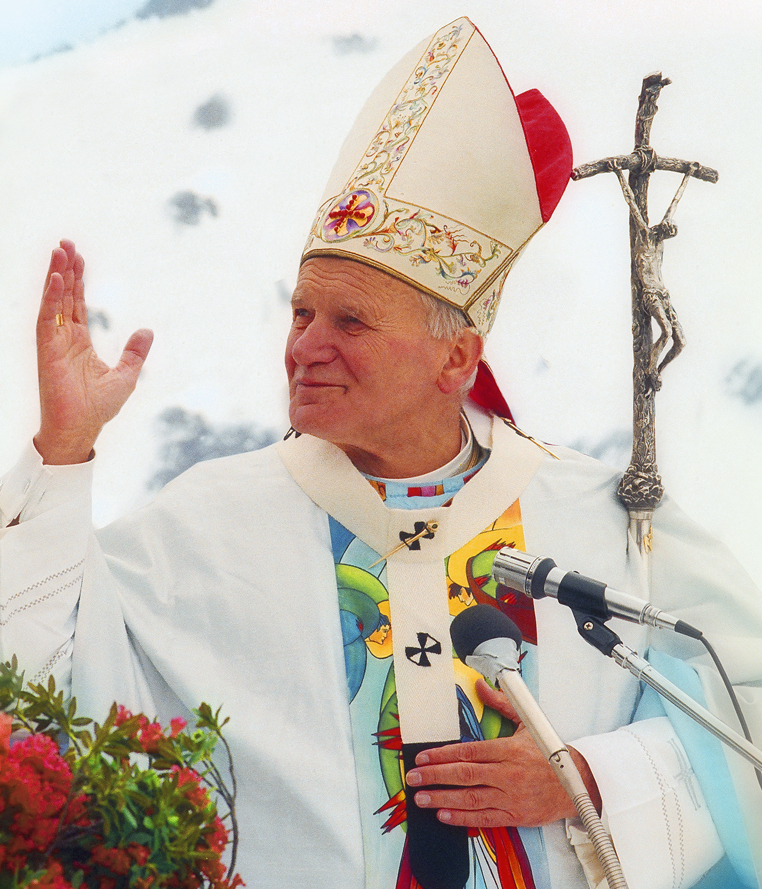
Scoring · Foundational moral figures
Pope John Paul II
papacy 1978–2005
Gregorini Demetrio. CC BY-SA 3.0 via Wikimedia Commons.
John Paul II's 'consistent ethic of life' bound the inviolability of innocent human life31 to opposition to abortion77, the death penalty76, and the exploitation of labor78. JPII's both/and theology splits both candidates more evenly than any other religious grader in the table — the closest religious-figure grade here.
Issue
Paxton
Talarico
Abortion
Helps
Hurts
Paxton: Helps · Talarico: Hurts
Traditional marriage
Helps
Hurts
Paxton: Helps · Talarico: Hurts
JPII held marriage to be 'the covenant of conjugal love' between 'man and woman'81; Paxton aligns, while Talarico's LGBTQ platform diverges from JPII's red line.
—
Hurts
Paxton: — · Talarico: Hurts
JPII-era Catholic teaching (Donum Vitae) holds homologous IVF 'in itself illicit and in opposition to the dignity of procreation'80; Talarico's pro-IVF posture costs him points, while Paxton's record is closer to the JPII position and does not move on this row.
Religious liberty
Helps
—
Paxton: Helps · Talarico: —
JPII taught that curtailing religious freedom 'is above all an attack on man's very dignity'82; Paxton's record on Christian-coded religious-liberty cases earns him credit here. Talarico's church-state separation framing is more First-Amendment than JPII-style and lands as a non-factor on this specific row.
Death penalty
Hurts
Helps
Paxton: Hurts · Talarico: Helps
JPII taught that punishment 'ought not go to the extreme of executing the offender, except in cases of absolute necessity,' which he judged 'very rare, if not practically non-existent'76; Texas leads the nation in executions and Paxton has defended that record, while Talarico opposes capital punishment.
Iraq War / war and peace
Hurts
—
Paxton: Hurts · Talarico: —
JPII told the Diplomatic Corps in 2003 that 'war is not always inevitable' and 'is always a defeat for humanity'83; Paxton's hawkish posture, reborn in opposition to peaceful resolution of current conflicts, runs against that. Talarico's foreign-policy framing is not pacifist either but stops short of JPII-flagged hawkishness and does not push him down here.
Anti-immigrant nativism
Hurts
Helps
Paxton: Hurts · Talarico: Helps
JPII charged the Church to be the Good Samaritan, 'making herself neighbour to all the rejected'84; Paxton's enforcement-only immigration posture (DACA litigation, Annunciation House) is the kind of policy JPII named directly, while Talarico's immigration platform tracks JPII's pro-migrant teaching2.
Labor (Laborem Exercens)
Hurts
Helps
Paxton: Hurts · Talarico: Helps
JPII's Laborem Exercens established 'the priority of labour over capital,' treating labour as the 'primary efficient cause' and capital as 'a mere instrument'78; Paxton is anti-union and has resisted worker protections, while Talarico supports collective bargaining and the PRO Act.
Healthcare as a right
Hurts
Helps
Paxton: Hurts · Talarico: Helps
Paxton's litigation against the ACA and Texas's refusal of Medicaid expansion bear on healthcare access, while Talarico's Medicaid-expansion and healthcare-as-right platform sits the other way. (No JPII primary-text source directly frames healthcare as a duty of solidarity, so this row carries no framework citation, per the HTD-6 drop-if-insufficient rule.)
Care for the poor
Hurts
Helps
Paxton: Hurts · Talarico: Helps
JPII's Centesimus Annus grounded the dignity of work in the person — 'man expresses and fulfils himself by working'79; Talarico's anti-poverty platform aligns, while Paxton has no anti-poverty agenda and his SNAP and child-welfare positions cut against JPII's preferential-option-for-the-poor teaching.
Sources
- Ken Paxton for U.S. Senate, official campaign issues page, accessed May 2026. (full list)
- Talarico for Texas, official campaign issues pages (taxes, education, healthcare, immigration, social media/AI, freedom-family-faith, public-safety-justice, corruption-democracy, labor-business), accessed May 2026. (full list)
- Pope John Paul II, Evangelium Vitae (1995), §57 — on the inviolability of innocent human life.
(full list)
I confirm that the direct and voluntary killing of an innocent human being is always gravely immoral. Encyclical Evangelium Vitae, §57 · accessed via vatican.va
- Pope John Paul II, Evangelium Vitae (1995), §56 — on the death penalty.
(full list)
[Punishment] ought not go to the extreme of executing the offender, except in cases of absolute necessity: in other words, when it would not be possible otherwise to defend society. Today, however, as a result of steady improvements in the organization of the penal system, such cases are very rare, if not practically non-existent. Encyclical Evangelium Vitae, §56 · accessed via vatican.va
- Pope John Paul II, Evangelium Vitae (1995), §62 — on abortion.
(full list)
I declare that direct abortion, that is, abortion willed as an end or as a means, always constitutes a grave moral disorder, since it is the deliberate killing of an innocent human being. Encyclical Evangelium Vitae, §62 · accessed via vatican.va
- Pope John Paul II, Laborem Exercens (1981), §12 — the priority of labour over capital.
(full list)
This principle directly concerns the process of production: in this process labour is always a primary efficient cause, while capital, the whole collection of means of production, remains a mere instrument or instrumental cause. This principle is an evident truth that emerges from the whole of man's historical experience. Encyclical Laborem Exercens, §12 ('the principle of the priority of labour over capital') · accessed via vatican.va
- Pope John Paul II, Centesimus Annus (1991), §6 — on the dignity of human work.
(full list)
Work thus belongs to the vocation of every person; indeed, man expresses and fulfils himself by working. Encyclical Centesimus Annus, §6 · accessed via vatican.va
- Congregation for the Doctrine of the Faith, Donum Vitae (1987), Part II.5 — homologous in vitro fertilization.
(full list)
the Church remains opposed from the moral point of view to homologous 'in vitro' fertilization. Such fertilization is in itself illicit and in opposition to the dignity of procreation and of the conjugal union, even when everything is done to avoid the death of the human embryo. CDF Instruction Donum Vitae, Part II, q.5 · accessed via vatican.va
- Pope John Paul II, Familiaris Consortio (1981), §11 — on marriage as the covenant of conjugal love.
(full list)
the covenant of conjugal love freely and consciously chosen, whereby man and woman accept the intimate community of life and love willed by God Himself Apostolic Exhortation Familiaris Consortio, §11 · accessed via vatican.va
- Pope John Paul II, Redemptor Hominis (1979), §17 — on religious freedom.
(full list)
Certainly the curtailment of the religious freedom of individuals and communities is not only a painful experience but it is above all an attack on man's very dignity, independently of the religion professed or of the concept of the world which these individuals and communities have. Encyclical Redemptor Hominis, §17 · accessed via vatican.va
- Pope John Paul II, Address to the Diplomatic Corps, 13 January 2003 — on war in Iraq.
(full list)
War is not always inevitable. It is always a defeat for humanity. Address to the Diplomatic Corps accredited to the Holy See, 13 January 2003 · accessed via vatican.va
- Pope John Paul II, Address to the 4th World Congress on the Pastoral Care of Migrants and Refugees, 9 October 1998 — on the dignity of migrants.
(full list)
the Church 'must assume ever more fully the Good Samaritan's role, making herself 'neighbour' to all the rejected' Address on the Pastoral Care of Migrants and Refugees, 9 October 1998 · accessed via vatican.va