Scoring · Other politicians & military leaders
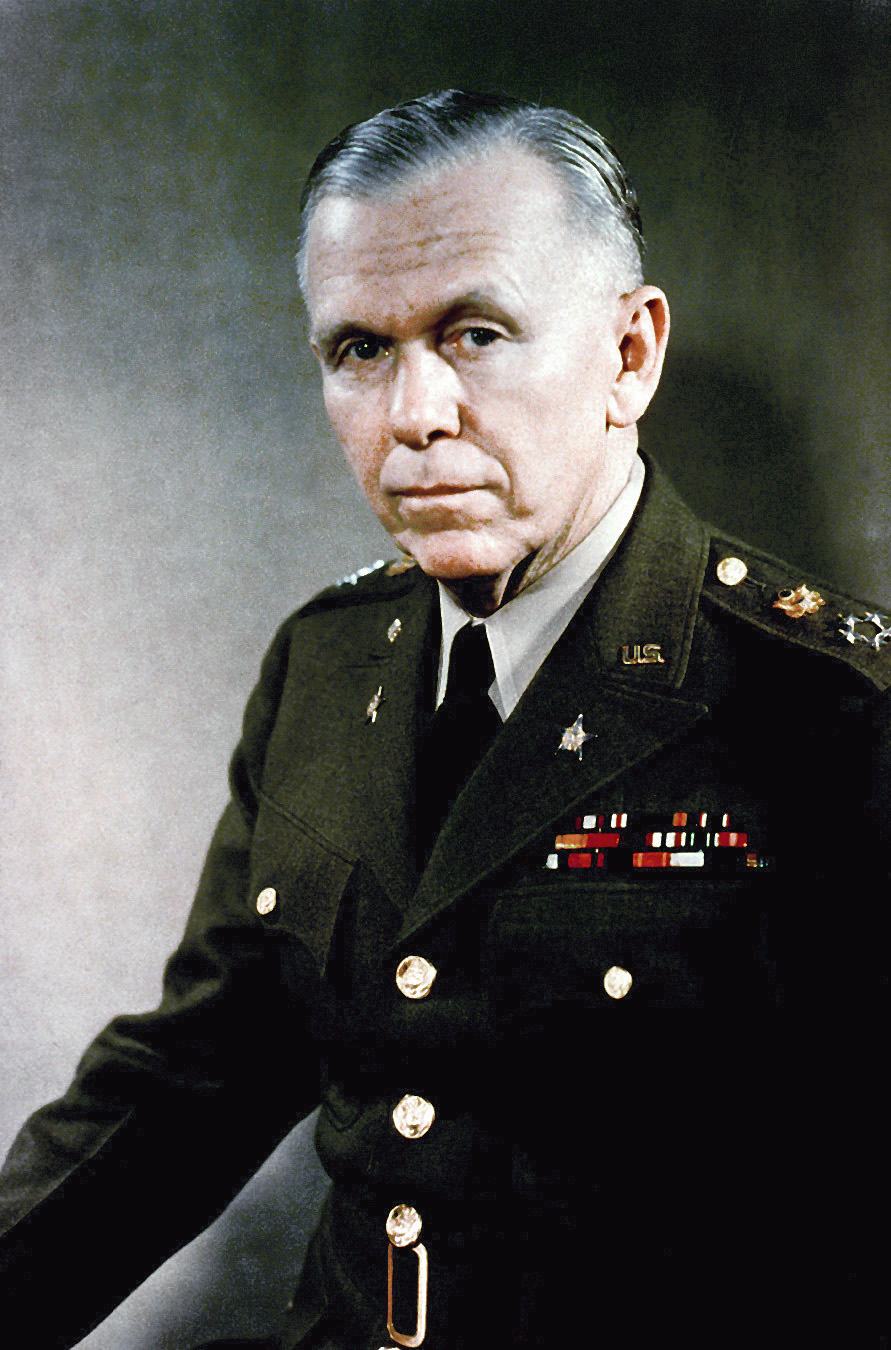
Marshall, George C.
1880–1959
Unknown author. Public domain via Wikimedia Commons.
Marshall's postwar institutional-soldier-statesman framework — the Marshall Plan as alliance investment, dual service as Secretary of State and Defense, the Nobel Peace Prize for diplomacy, and his refusal of commercial memoirs as a statement that institutions outlast individuals — runs hard against Paxton's personal-loyalty politics, abuse-of-office impeachment, anti-institutional campaign style, and alliance-skepticism on Ukraine aid, and aligns with Talarico's alliance-restoration foreign policy, institutionalist temperament, anti-corruption package, infrastructure-investment framing, and rejection of personality politics, with two points off Talarico for populist economics Marshall would have found expansionist.58
Issue
Paxton
Talarico
Marshall Plan / alliance investment
Hurts
Helps
Paxton: Hurts · Talarico: Helps
Marshall's defining act was $13 billion in 1948 dollars rebuilding defeated enemies as alliance investment;58 Paxton's alliance-skeptical posture and opposition to Ukraine aid is the precise inverse of that framework, while Talarico's alliance-restoration foreign policy and Ukraine support2 is its modern translation.
Institutions over individuals (refused commercial memoirs)
Hurts
Helps
Paxton: Hurts · Talarico: Helps
Marshall declined publisher offers worth millions and structured his career around institutions outlasting individuals;58 Paxton's personal-loyalty politics and attacks on institutions for partisan advantage are exactly what Marshall worked against, while Talarico's explicit rejection of personality politics and anti-corruption package2 tracks Marshall's posture.
Public-office integrity
Hurts
Helps
Paxton: Hurts · Talarico: Helps
Marshall's reputation rested on uncompromising public-office integrity; Paxton's abuse-of-office impeachment is the kind of personal misconduct Marshall treated as disqualifying, while Talarico's SCOTUS-ethics, financial-disclosure, and gift-limit package2 codifies Marshall's integrity ethic.
Diplomacy-first foreign policy (Nobel Peace Prize)
Hurts
Helps
Paxton: Hurts · Talarico: Helps
Infrastructure investment as alliance-building
—
Helps
Paxton: — · Talarico: Helps
The Marshall Plan was infrastructure investment at scale as a strategic instrument; Talarico's domestic infrastructure-investment framing2 is the modern domestic analog. Paxton has not staked out a federal infrastructure-investment position on this specific row.
Populist economic expansion
—
Hurts
Paxton: — · Talarico: Hurts
Marshall was a fiscal-conservative institutionalist who would have found Talarico's more populist economic policies2 troublingly expansionist, costing him a couple of points. Paxton's economic posture is not populist-expansionist in Talarico's sense, but his Trump-aligned tariff support1 is its own form of populist economics that Marshall's fiscal-conservative tradition would also reject, so he earns no clean credit on this row.
Sources
- Ken Paxton for U.S. Senate, official campaign issues page, accessed May 2026. (full list)
- Talarico for Texas, official campaign issues pages (taxes, education, healthcare, immigration, social media/AI, freedom-family-faith, public-safety-justice, corruption-democracy, labor-business), accessed May 2026. (full list)
- George C. Marshall, Marshall Plan speech at Harvard, June 5, 1947; Nobel Peace Prize lecture (1953); refusal to write memoirs for commercial profit; biographical record as Army Chief of Staff (1939-1945) and Secretary of State (1947-1949); Eisenhower's tribute and personal correspondence. (full list)