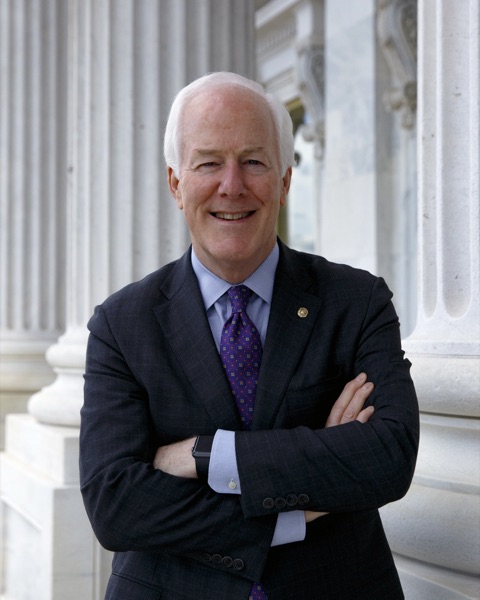
Office of U.S. Senator John Cornyn
John Cornyn (R)
U.S. Senator, Texas (2002–present)
Career
- 2002–present U.S. Senator, Texas
- 1999–2002 Attorney General of Texas
- 1991–1997 Associate Justice, Texas Supreme Court
- 1985–1991 Judge, Texas 37th District Court
- 1977–1985 Private law practice, San Antonio (medical malpractice defense)
Education
B.A. Journalism, Trinity University (1973); J.D., St. Mary's University School of Law (1977); LL.M., University of Virginia School of Law (1995)
Notable credentials
- Senate Republican Whip, 2013–2019
- Chair, National Republican Senatorial Committee, 2009–2013
- First Republican Texas Attorney General since Reconstruction (1999)
Races covered on this site
Stances on the issues
Every documented position Cornyn has taken on the policy areas covered by this site. When the same position applies across multiple races it is shown once; when wording differs per race it is split out.
Taxes
Cornyn voted for the 2017 Tax Cuts and Jobs Act and has consistently pushed to make the individual rate cuts permanent before they snap back in 2025. As a senior Finance Committee Republican, he prioritizes making 100% bonus depreciation and R&D expensing permanent and supports permanent estate-tax repeal. He has filed multiple HSA-expansion bills and opposes raising the corporate rate, restoring the carried-interest framework, or expanding the Child Tax Credit beyond 2017 levels. He has been notably skeptical — though rarely openly oppositional — of the broadest Trump tariffs, framing them as a tax on Texas exporters in private remarks reported by the Texas Tribune Q&A. He has not endorsed Trump's 50-year mortgage proposal and has expressed concern about ballooning federal debt from extending the tax cuts without offsets.
Sources:
- Sen. John Cornyn, official Senate website and 2026 re-election campaign issues page, accessed May 2026 (cornyn.senate.gov; johncornyn.com).
- Gabby Birenbaum, 'On the issues: A Q&A with Ken Paxton and John Cornyn,' Texas Tribune, April 20, 2026; companion Cornyn interview, April 2026.
- Cornyn votes on USMCA (January 2020), TPP procedural votes; Senate Finance Committee record on free-trade agreements; Cornyn statements on Trump-era tariffs (2018-2026) including measured opposition to broad agricultural tariffs harming Texas exporters.
Cornyn voted for the 2017 Tax Cuts and Jobs Act and has consistently pushed to make the individual rate cuts permanent before they snap back in 2025. As a senior Finance Committee Republican, he prioritizes making 100% bonus depreciation and R&D expensing permanent and supports permanent estate-tax repeal. He has filed multiple HSA-expansion bills and opposes raising the corporate rate. He has been notably skeptical — though rarely openly oppositional — of the broadest Trump tariffs, framing them as a tax on Texas exporters in private remarks reported by the Texas Tribune Q&A. He has expressed concern about ballooning federal debt from extending the tax cuts without offsets, while voting consistently to extend the cuts.
Sources:
- Sen. John Cornyn, official Senate website and 2026 re-election campaign issues page, accessed May 2026 (cornyn.senate.gov; johncornyn.com).
- Gabby Birenbaum, 'On the issues: A Q&A with Ken Paxton and John Cornyn,' Texas Tribune, April 20, 2026.
- Cornyn votes on USMCA (January 2020); Senate Finance Committee record on free-trade agreements; Cornyn statements on Trump-era tariffs (2018-2026) including measured opposition to broad agricultural tariffs harming Texas exporters.
School Funding
Cornyn has voted for Title I and IDEA appropriations every cycle and supports increased Pell Grant funding while opposing the Biden-era student-loan-forgiveness executive orders. He co-sponsored expanded 529 plans for K-12 expenses, federal school-choice tax credits, and the Educational Choice for Children Act, and supports the Trump administration's school-choice priority though he has not signed onto the most aggressive federal preemption proposals. He has opposed eliminating the Department of Education while supporting significant restructuring of its civil-rights and student-loan functions. He has championed full IDEA funding — an unfulfilled 40% federal commitment dating to 1975 — and supports the Teacher Quality Partnership program. He treats school-funding policy as primarily a state-level question, citing federalism limits.
Cornyn has voted for Title I and IDEA appropriations every cycle and supports increased Pell Grant funding while opposing the Biden-era student-loan-forgiveness executive orders. He co-sponsored expanded 529 plans for K-12 expenses, federal school-choice tax credits, and the Educational Choice for Children Act, and supports the Trump administration's school-choice priority though he has not signed onto the most aggressive federal preemption proposals. He has opposed eliminating the Department of Education while supporting significant restructuring of its civil-rights and student-loan functions. He has championed full IDEA funding — an unfulfilled 40% federal commitment dating to 1975. He treats school-funding policy as primarily a state-level question, citing federalism limits.
AI / Data Centers
Cornyn co-sponsored the CREATE AI Act funding the National AI Research Resource (NAIRR) and the AI Risk Evaluation Act, framing AI policy as the next-generation national-security competition with China. He helped negotiate the CHIPS and Science Act, which directed billions to TSMC-Arizona and Samsung-Taylor and which he treats as one of his signature legacy accomplishments. He is a primary sponsor of legislation funding the Texas Semiconductor Innovation Consortium and has championed advanced-AI-chip export controls through his Senate Intelligence Committee work. He has been measured on the local data-center moratorium debate — supporting local property-rights deference while opposing the most aggressive state preemption of local rules — and has not endorsed broad federal preemption of state AI regulation. His framework treats AI infrastructure investment as bipartisan national-security policy, not a culture-war battlefield.
Sources:
- Sen. John Cornyn, official Senate website and 2026 re-election campaign issues page, accessed May 2026 (cornyn.senate.gov; johncornyn.com).
- Gabby Birenbaum, 'On the issues: A Q&A with Ken Paxton and John Cornyn,' Texas Tribune, April 20, 2026; companion Cornyn interview, April 2026.
- Cornyn votes on Ukraine Supplemental Appropriations (April 2024, $61B package); Cornyn statements on Israel aid and Iron Dome funding; Senate Foreign Relations Committee record on NATO and AUKUS.
Cornyn co-sponsored the CREATE AI Act funding the National AI Research Resource (NAIRR) and the AI Risk Evaluation Act, framing AI policy as the next-generation national-security competition with China. He helped negotiate the CHIPS and Science Act, which directed billions to TSMC-Arizona and Samsung-Taylor and which he treats as one of his signature legacy accomplishments. He is a primary sponsor of legislation funding the Texas Semiconductor Innovation Consortium and has championed advanced-AI-chip export controls through his Senate Intelligence Committee work. He has been measured on the local data-center moratorium debate — supporting local property-rights deference while opposing state preemption of local rules. His framework treats AI infrastructure investment as bipartisan national-security policy, not a culture-war battlefield.
Sources:
- Sen. John Cornyn, official Senate website and 2026 re-election campaign issues page, accessed May 2026 (cornyn.senate.gov; johncornyn.com).
- Gabby Birenbaum, 'On the issues: A Q&A with Ken Paxton and John Cornyn,' Texas Tribune, April 20, 2026.
- Cornyn votes on Ukraine Supplemental Appropriations (April 2024, $61B package); Cornyn statements on Israel aid and Iron Dome funding; Senate Foreign Relations Committee record on NATO and AUKUS.
Corruption / Ethics
Cornyn voted to certify Joe Biden's 2020 Electoral College victory on January 6, 2021, declining to join the House Republican objectors and publicly calling the Capitol attack 'shameful.' He voted to acquit Trump in both impeachments while criticizing the conduct in each case. He has co-sponsored the Sunshine in the Courtroom Act for federal court transparency and has historically supported FARA reform, PAC disclosure modernization, and STOCK Act enforcement. He has opposed the most aggressive congressional-stock-trading-ban proposals on First Amendment grounds while supporting tighter timely-disclosure requirements. He has been a vocal critic of pardon-power abuse on both sides historically, and has called for Senate Ethics Committee enforcement against members of both parties when public conduct breaches occur.
Sources:
- Sen. John Cornyn, official Senate website and 2026 re-election campaign issues page, accessed May 2026 (cornyn.senate.gov; johncornyn.com).
- Senate Republican Whip (2013-2019); 2024 Senate Republican Leader race vs. Sen. John Thune (Cornyn lost 29-23); Republican Conference institutional record; New York Times coverage of Cornyn-Thune-Scott three-way race, November 2024.
Cornyn voted to certify Joe Biden's 2020 Electoral College victory on January 6, 2021, declining to join the House Republican objectors and publicly calling the Capitol attack 'shameful.' He voted to acquit Trump in both impeachments while criticizing the conduct in each case. He has co-sponsored the Sunshine in the Courtroom Act for federal court transparency and has historically supported FARA reform, PAC disclosure modernization, and STOCK Act enforcement. He has opposed the most aggressive congressional-stock-trading-ban proposals on First Amendment grounds while supporting tighter timely-disclosure requirements. As a former Texas Supreme Court Justice and former Texas Attorney General, his decades-long professional record carries no pending misconduct charges and no impeachment — the cleanest institutional record any current Texas Republican senator could bring to this primary.
Sources:
- Sen. John Cornyn, official Senate website and 2026 re-election campaign issues page, accessed May 2026 (cornyn.senate.gov; johncornyn.com).
- Cornyn as senior Senate Judiciary Committee Republican (2015-present); record on confirmations of Justices Gorsuch, Kavanaugh, Barrett, and Jackson; Cornyn-Coons Sunshine in the Courtroom Act.
- Senate Republican Whip (2013-2019); 2024 Senate Republican Leader race vs. Sen. John Thune (Cornyn lost 29-23); Republican Conference institutional record; New York Times coverage of Cornyn-Thune-Scott three-way race, November 2024.
Healthcare
Cornyn voted for every major ACA repeal-and-replace attempt — the 2017 skinny repeal, the BCRA, and Graham-Cassidy — and opposes extending the enhanced premium tax credits that expire in 2025. He supports Health Savings Account expansion, association health plans for small businesses, and Medicaid block grants to states. He voted for the Inflation Reduction Act's $35 Medicare insulin cap but against the broader prescription-drug-price-negotiation framework, calling it price controls. He has championed mental-health-parity enforcement, the 988 Suicide and Crisis Lifeline, and rural-hospital relief legislation that targets the closures hitting Texas hardest. He treats Talarico's Medicare buy-in as a first step toward single-payer and has consistently voted against any public-option framework.
Sources:
- Sen. John Cornyn, official Senate website and 2026 re-election campaign issues page, accessed May 2026 (cornyn.senate.gov; johncornyn.com).
- Cornyn votes on ACA repeal-and-replace (2017 skinny repeal, BCRA, Graham-Cassidy); Cornyn as co-sponsor of Health Savings Account expansion; statements on Medicare/Medicaid block grants; opposition to enhanced premium tax credit extension (2025).
Cornyn voted for every major ACA repeal-and-replace attempt — the 2017 skinny repeal, the BCRA, and Graham-Cassidy — and opposes extending the enhanced premium tax credits that expire in 2025. He supports Health Savings Account expansion, association health plans for small businesses, and Medicaid block grants to states. He voted for the Inflation Reduction Act's $35 Medicare insulin cap but against the broader prescription-drug-price-negotiation framework, calling it price controls. He has championed mental-health-parity enforcement, the 988 Suicide and Crisis Lifeline, and rural-hospital relief legislation that targets the closures hitting Texas hardest. He has consistently voted against any public-option framework.
Sources:
- Sen. John Cornyn, official Senate website and 2026 re-election campaign issues page, accessed May 2026 (cornyn.senate.gov; johncornyn.com).
- Cornyn votes on ACA repeal-and-replace (2017 skinny repeal, BCRA, Graham-Cassidy); Cornyn as co-sponsor of Health Savings Account expansion; statements on Medicare/Medicaid block grants; opposition to enhanced premium tax credit extension (2025).
Religion / Church-State
Cornyn was one of 12 Senate Republicans who voted for the Respect for Marriage Act in 2022, providing federal recognition for both same-sex and interracial marriages while building in religious-liberty protections for nonprofits and houses of worship. He has consistently voted for religious-liberty protections including the Equal Access Act and supports Title VII religious-employer accommodations. He has not co-sponsored federal Ten Commandments classroom mandates or chaplaincy laws, treating those as state-level questions where federal preemption is unwarranted. He attends Highland Park Presbyterian Church in Dallas and frames his faith in personal rather than majoritarian terms. He has been measured in the Paxton-led litigation against Muslim and Catholic institutions, declining to endorse the investigative posture against CAIR, East Plano Islamic Center, or Annunciation House.
Cornyn was one of 12 Senate Republicans who voted for the Respect for Marriage Act in 2022, providing federal recognition for both same-sex and interracial marriages while building in religious-liberty protections for nonprofits and houses of worship — a vote Paxton has attacked repeatedly in this primary. He has consistently voted for religious-liberty protections including the Equal Access Act and supports Title VII religious-employer accommodations. He has not co-sponsored federal Ten Commandments classroom mandates or chaplaincy laws, treating those as state-level questions where federal preemption is unwarranted. He attends Highland Park Presbyterian Church in Dallas and frames his faith in personal rather than majoritarian terms. He has been measured in the Paxton-led litigation against Muslim and Catholic institutions, declining to endorse the investigative posture against CAIR, East Plano Islamic Center, or Annunciation House.
Sources:
- Sen. John Cornyn, official Senate website and 2026 re-election campaign issues page, accessed May 2026 (cornyn.senate.gov; johncornyn.com).
- National Right to Life Committee Cornyn voting record (100% NRLC lifetime); Susan B. Anthony List endorsement record; co-sponsor of Pain-Capable Unborn Child Protection Act; Respect for Marriage Act vote (Dec. 2022) — one of 12 Senate Republicans to support.
The Economy
Cornyn has been a consistently free-trade Republican: voted for USMCA in 2020, opposed (in measured language) the broadest Trump agricultural tariffs, and helped pass the CHIPS and Science Act with bipartisan majorities. He supports energy dominance including LNG export expansion, pipeline-permitting reform, and the Texas crypto framework including the CLARITY Act. He opposes the IRA's most aggressive renewable-energy subsidies but supports tax credits for carbon capture and methane reduction. He has co-sponsored the Open App Markets Act and the Journalism Competition and Preservation Act, both bipartisan antitrust-adjacent measures focused on tech platforms. He has not endorsed Trump's 50-year mortgage proposal and has publicly worried about ballooning deficits from extending tax cuts without offsets.
Sources:
- Sen. John Cornyn, official Senate website and 2026 re-election campaign issues page, accessed May 2026 (cornyn.senate.gov; johncornyn.com).
- Cornyn votes on USMCA (January 2020), TPP procedural votes; Senate Finance Committee record on free-trade agreements; Cornyn statements on Trump-era tariffs (2018-2026) including measured opposition to broad agricultural tariffs harming Texas exporters.
Cornyn has been a consistently free-trade Republican: voted for USMCA in 2020, opposed (in measured language) the broadest Trump agricultural tariffs, and helped pass the CHIPS and Science Act with bipartisan majorities. He supports energy dominance including LNG export expansion, pipeline-permitting reform, and the Texas crypto framework including the CLARITY Act. He opposes the IRA's most aggressive renewable-energy subsidies but supports tax credits for carbon capture and methane reduction. He has not endorsed Trump's 50-year mortgage proposal and has publicly worried about ballooning deficits from extending tax cuts without offsets. His free-trade posture is the cleanest substantive economic break from Paxton in this primary.
Sources:
- Sen. John Cornyn, official Senate website and 2026 re-election campaign issues page, accessed May 2026 (cornyn.senate.gov; johncornyn.com).
- Cornyn votes on USMCA (January 2020); Senate Finance Committee record on free-trade agreements; Cornyn statements on Trump-era tariffs (2018-2026) including measured opposition to broad agricultural tariffs harming Texas exporters.
Small Business
Cornyn co-sponsored the Small Business Tax Fairness Act expanding Section 199A pass-through deductions, the Save Local Business Act limiting joint-employer expansion, and the JOBS Credit Act supporting hiring incentives. He supports permanent QBI for pass-through entities, 100% bonus depreciation, and reforms to the Bank Secrecy Act for small-business community-bank lending. He voted for the Corporate Transparency Act's BOI reporting framework but has subsequently championed small-business carve-outs and has supported the Texas-led litigation against the rule's broadest applications. He has consistently received the U.S. Chamber of Commerce 'Spirit of Enterprise' award and the NFIB 'Guardian of Small Business' award. He treats regulatory predictability as a core small-business priority, in implicit contrast with Paxton's litigation-heavy AG style.
Cornyn co-sponsored the Small Business Tax Fairness Act expanding Section 199A pass-through deductions, the Save Local Business Act limiting joint-employer expansion, and the JOBS Credit Act supporting hiring incentives. He supports permanent QBI for pass-through entities, 100% bonus depreciation, and reforms to the Bank Secrecy Act for small-business community-bank lending. He voted for the Corporate Transparency Act's BOI reporting framework but has subsequently championed small-business carve-outs. He has consistently received the U.S. Chamber of Commerce 'Spirit of Enterprise' award and the NFIB 'Guardian of Small Business' award. He treats regulatory predictability as a core small-business priority, in implicit contrast with Paxton's litigation-heavy AG style.
Immigration (legal pathway)
Cornyn engaged with the 2013 Gang of Eight immigration reform — adding the 'border surge' Cornyn-Hoeven amendment that doubled Border Patrol agents to 38,405 — but ultimately voted against the final bill citing path-to-citizenship concerns. He co-sponsored the 2024 Lankford-Murphy-Sinema border-security framework which collapsed under House Republican opposition after Trump's intervention, and he publicly defended the package's enforcement provisions. He supports increased H-1B and H-2A allocations for skilled and agricultural labor, has championed DACA-recipient legal certainty in narrower bills, and voted to fund the border wall. He has been measured in the Paxton-led litigation against DACA, supporting the legal challenge while publicly endorsing congressional action to provide certainty for long-term residents. He has co-sponsored remain-in-Mexico-style enforcement frameworks while opposing family separation in policy and rhetoric.
Sources:
- Sen. John Cornyn, official Senate website and 2026 re-election campaign issues page, accessed May 2026 (cornyn.senate.gov; johncornyn.com).
- Gabby Birenbaum, 'On the issues: A Q&A with Ken Paxton and John Cornyn,' Texas Tribune, April 20, 2026; companion Cornyn interview, April 2026.
- Cornyn vote on S. 744, Border Security, Economic Opportunity, and Immigration Modernization Act, June 27, 2013 (voted no on final passage after Gang of Eight engagement); RESULTS Act / Cornyn-Heller substitute amendment; 'border surge' Cornyn-Hoeven amendment incorporated into the bill.
Cornyn engaged with the 2013 Gang of Eight immigration reform — adding the 'border surge' Cornyn-Hoeven amendment that doubled Border Patrol agents to 38,405 — but ultimately voted against the final bill citing path-to-citizenship concerns. He co-sponsored the 2024 Lankford-Murphy-Sinema border-security framework which collapsed under House Republican opposition after Trump's intervention, and he publicly defended the package's enforcement provisions. He supports increased H-1B and H-2A allocations for skilled and agricultural labor and has championed DACA-recipient legal certainty in narrower bills. He has been measured in the Paxton-led litigation against DACA, supporting the legal challenge while publicly endorsing congressional action to provide certainty for long-term residents. He has co-sponsored remain-in-Mexico-style enforcement frameworks while opposing family separation in policy and rhetoric.
Sources:
- Sen. John Cornyn, official Senate website and 2026 re-election campaign issues page, accessed May 2026 (cornyn.senate.gov; johncornyn.com).
- Gabby Birenbaum, 'On the issues: A Q&A with Ken Paxton and John Cornyn,' Texas Tribune, April 20, 2026.
- Cornyn vote on S. 744, Border Security, Economic Opportunity, and Immigration Modernization Act, June 27, 2013; RESULTS Act / Cornyn-Heller substitute amendment; 'border surge' Cornyn-Hoeven amendment incorporated into the bill.
Marijuana
Cornyn has consistently opposed federal marijuana legalization, rescheduling, and decriminalization, citing public-health and law-enforcement concerns. He voted against the MORE Act in committee work and has expressed concern about the SAFER Banking Act's interaction with federal scheduling. He supported the Hemp Farming Act's regulated industrial hemp framework but has expressed concern about delta-8 THC loopholes and supports federal-level closure of the high-THC hemp gap. He has not joined Paxton's lawsuits against Texas municipalities over local decriminalization ordinances and treats those as a state matter. He has not engaged with Talarico's HB 4089 / HB 5307 framework directly but his stated federal position is incompatible with state-level adult-use legalization.
Cornyn has consistently opposed federal marijuana legalization, rescheduling, and decriminalization, citing public-health and law-enforcement concerns. He voted against the MORE Act in committee work and has expressed concern about the SAFER Banking Act's interaction with federal scheduling. He supported the Hemp Farming Act's regulated industrial hemp framework but has expressed concern about delta-8 THC loopholes and supports federal-level closure of the high-THC hemp gap. He has not joined Paxton's lawsuits against Texas municipalities over local decriminalization ordinances and treats those as a state matter. The two candidates broadly agree on the federal-prohibition framework but diverge on AG-style enforcement against local municipalities.
Gun Rights
Cornyn co-authored the Bipartisan Safer Communities Act (2022) with Sen. Chris Murphy — the first major federal gun-safety legislation in nearly 30 years — which expanded background checks for buyers under 21, closed the 'boyfriend loophole' for domestic abusers, funded state red-flag programs without mandating them, and authorized $13B in school mental-health funding. The NRA downgraded his rating from A+ to A in response, and Gun Owners of America has explicitly opposed Cornyn over BSCA — the same group endorsing Paxton in this primary. He previously authored the Fix NICS Act (2018) after the Sutherland Springs church shooting in his hometown region, strengthening the federal background-check database. He otherwise opposes assault-weapons bans, universal background checks beyond the 21-and-under expansion, and high-capacity-magazine restrictions, and has been a strong Second Amendment voice in floor speeches and committee work. He has framed his record as 'protect the Second Amendment AND keep guns from people who shouldn't have them.'
Sources:
- Sen. John Cornyn, official Senate website and 2026 re-election campaign issues page, accessed May 2026 (cornyn.senate.gov; johncornyn.com).
- Bipartisan Safer Communities Act, Pub. L. 117-159 (June 25, 2022); Senate vote 65-33; Cornyn as lead Republican negotiator with Sen. Chris Murphy; NRA 'A+' downgrade letter, June 2022; floor speech June 21, 2022.
- Cornyn-Murphy Fix NICS Act, signed into law March 2018 as part of the Consolidated Appropriations Act; Sutherland Springs church shooting (Nov. 5, 2017) Cornyn response; American Bar Association testimony record.
Cornyn co-authored the Bipartisan Safer Communities Act (2022) with Sen. Chris Murphy — the first major federal gun-safety legislation in nearly 30 years — which expanded background checks for buyers under 21, closed the 'boyfriend loophole' for domestic abusers, funded state red-flag programs without mandating them, and authorized $13B in school mental-health funding. The NRA downgraded his rating from A+ to A in response, and Gun Owners of America has explicitly opposed Cornyn over BSCA — the same group endorsing Paxton in this primary. He previously authored the Fix NICS Act (2018) after the Sutherland Springs church shooting in his hometown region. He otherwise opposes assault-weapons bans, universal background checks beyond the 21-and-under expansion, and high-capacity-magazine restrictions, and has been a strong Second Amendment voice in floor speeches and committee work. The BSCA vote is the single sharpest substantive issue line in this primary — the moment Paxton's campaign cites most often.
Sources:
- Sen. John Cornyn, official Senate website and 2026 re-election campaign issues page, accessed May 2026 (cornyn.senate.gov; johncornyn.com).
- Bipartisan Safer Communities Act, Pub. L. 117-159 (June 25, 2022); Senate vote 65-33; Cornyn as lead Republican negotiator with Sen. Chris Murphy; NRA 'A+' downgrade letter, June 2022; floor speech June 21, 2022.
- Cornyn-Murphy Fix NICS Act, signed into law March 2018 as part of the Consolidated Appropriations Act; Sutherland Springs church shooting (Nov. 5, 2017) Cornyn response.
Care for Aging / Sick
Cornyn co-sponsored the Improving Care Coordination for Medicare Advantage Beneficiaries Act and has championed Older Americans Act reauthorization and the Lifespan Respite Care caregiver-support program funding. He supports Medicare Advantage expansion as the preferred private-sector alternative to public-option proposals and has consistently voted against converting Medicare into a public option. He has been a primary author of rural-hospital relief legislation targeting Texas closures and supports the rural emergency hospital designation funding. He opposes Social Security tax-cap elimination but has not signed onto direct benefit cuts and has supported solvency frameworks raising the retirement age gradually. He has voted against every recent Medicaid expansion proposal and supports converting Medicaid to a block-grant framework giving states more flexibility — and less federal funding growth.
Sources:
- Sen. John Cornyn, official Senate website and 2026 re-election campaign issues page, accessed May 2026 (cornyn.senate.gov; johncornyn.com).
- Cornyn votes on ACA repeal-and-replace (2017 skinny repeal, BCRA, Graham-Cassidy); Cornyn as co-sponsor of Health Savings Account expansion; statements on Medicare/Medicaid block grants; opposition to enhanced premium tax credit extension (2025).
Cornyn co-sponsored the Improving Care Coordination for Medicare Advantage Beneficiaries Act and has championed Older Americans Act reauthorization and the Lifespan Respite Care caregiver-support program funding. He supports Medicare Advantage expansion as the preferred private-sector alternative to public-option proposals and has consistently voted against converting Medicare into a public option. He has been a primary author of rural-hospital relief legislation targeting Texas closures. He opposes Social Security tax-cap elimination but has not signed onto direct benefit cuts and has supported solvency frameworks raising the retirement age gradually. He has voted against every recent Medicaid expansion proposal and supports converting Medicaid to a block-grant framework giving states more flexibility — and less federal funding growth.
Sources:
- Sen. John Cornyn, official Senate website and 2026 re-election campaign issues page, accessed May 2026 (cornyn.senate.gov; johncornyn.com).
- Cornyn votes on ACA repeal-and-replace (2017 skinny repeal, BCRA, Graham-Cassidy); Cornyn as co-sponsor of Health Savings Account expansion; statements on Medicare/Medicaid block grants; opposition to enhanced premium tax credit extension (2025).
LGBTQ / Social Issues
Cornyn voted for the Respect for Marriage Act (2022), one of 12 Senate Republicans to do so, providing federal recognition for both same-sex and interracial marriages — a vote Paxton has attacked him over repeatedly in the primary. He has otherwise voted for the Born Alive Survivors Protection Act, the Pain-Capable Unborn Child Protection Act, and against the Equality Act, and maintains an NRLC 100% pro-life rating across decades of voting. He has not co-sponsored federal 'Don't Say Gay,' transgender-sports, or gender-affirming-care-prohibition legislation and has been measured on the Texas Children's Hospital gender-affirming care debate. He has not engaged the Trump IVF accessibility plan publicly. His record reads as standard institutional Republican social conservatism with a specific carve-out for civil-marriage recognition.
Sources:
- Sen. John Cornyn, official Senate website and 2026 re-election campaign issues page, accessed May 2026 (cornyn.senate.gov; johncornyn.com).
- National Right to Life Committee Cornyn voting record (100% NRLC lifetime); Susan B. Anthony List endorsement record; co-sponsor of Pain-Capable Unborn Child Protection Act; floor speeches on Dobbs v. Jackson (June 2022).
Cornyn voted for the Respect for Marriage Act (2022), one of 12 Senate Republicans to do so, providing federal recognition for both same-sex and interracial marriages — a vote Paxton has attacked him over repeatedly in the primary. He has otherwise voted for the Born Alive Survivors Protection Act, the Pain-Capable Unborn Child Protection Act, and against the Equality Act, and maintains an NRLC 100% pro-life rating across decades of voting. He has not co-sponsored federal 'Don't Say Gay,' transgender-sports, or gender-affirming-care-prohibition legislation and has been measured on the Texas Children's Hospital gender-affirming care debate. His record reads as standard institutional Republican social conservatism with a specific carve-out for civil-marriage recognition — the single doctrinal issue separating him from Paxton on cultural conservatism.
Sources:
- Sen. John Cornyn, official Senate website and 2026 re-election campaign issues page, accessed May 2026 (cornyn.senate.gov; johncornyn.com).
- National Right to Life Committee Cornyn voting record (100% NRLC lifetime); Susan B. Anthony List endorsement record; co-sponsor of Pain-Capable Unborn Child Protection Act; Respect for Marriage Act vote (Dec. 2022) — one of 12 Senate Republicans to support.
Foreign Policy
Cornyn is a senior Republican on Senate Foreign Relations and one of the Senate's most consistent China and Russia hawks across two decades, including authorship of multiple semiconductor export-control packages aimed at the PRC. He voted for the Ukraine Supplemental Appropriations Acts including the April 2024 $61B package, strongly supports Israel and Iron Dome funding, and is a primary author of multiple sanctions packages against Russia and Iran. He has consistently championed NATO expansion and AUKUS, opposed any framework that would require Ukraine to cede territory to end the war, and publicly opposed USMCA withdrawal. He has been openly critical — in measured language — of Trump's broadest tariffs as harmful to allied trade relationships, and supports the Taiwan Relations Act framework. His foreign policy is the cleanest substantive break from Paxton in this primary.
Sources:
- Sen. John Cornyn, official Senate website and 2026 re-election campaign issues page, accessed May 2026 (cornyn.senate.gov; johncornyn.com).
- Cornyn votes on Ukraine Supplemental Appropriations (April 2024, $61B package); Cornyn statements on Israel aid and Iron Dome funding; Senate Foreign Relations Committee record on NATO and AUKUS.
- Cornyn votes on USMCA (January 2020), TPP procedural votes; Senate Finance Committee record on free-trade agreements; Cornyn statements on Trump-era tariffs (2018-2026) including measured opposition to broad agricultural tariffs harming Texas exporters.
Cornyn is a senior Republican on Senate Foreign Relations and one of the Senate's most consistent China and Russia hawks across two decades, including authorship of multiple semiconductor export-control packages aimed at the PRC. He voted for the Ukraine Supplemental Appropriations Acts including the April 2024 $61B package, strongly supports Israel and Iron Dome funding, and is a primary author of multiple sanctions packages against Russia and Iran. He has consistently championed NATO expansion and AUKUS, opposed any framework that would require Ukraine to cede territory to end the war, and publicly opposed USMCA withdrawal. He has been openly critical — in measured language — of Trump's broadest tariffs as harmful to allied trade relationships. His foreign policy is the cleanest substantive break from Paxton in this primary, beyond the RFMA and BSCA votes.
Sources:
- Sen. John Cornyn, official Senate website and 2026 re-election campaign issues page, accessed May 2026 (cornyn.senate.gov; johncornyn.com).
- Cornyn votes on Ukraine Supplemental Appropriations (April 2024, $61B package); Cornyn statements on Israel aid and Iron Dome funding; Senate Foreign Relations Committee record on NATO and AUKUS.
- Cornyn votes on USMCA (January 2020); Senate Finance Committee record on free-trade agreements; Cornyn statements on Trump-era tariffs (2018-2026) including measured opposition to broad agricultural tariffs harming Texas exporters.